Resistor Definition

Resistor definition
A resistor is an electrical component that limits or regulates the flow of electrical current in an electronic circuit. Resistors can also be used to provide a specific voltage for an active device such as a transistor.
What is resistor and its uses?
A resistor is a two-terminal electrical component that provides electrical resistance. In electronic circuits, resistors are predominantly used to lower the flow of current, divide voltages, block transmission signals, and bias active elements.
What is in a resistor?
Resistor Composition Most common, modern resistors are made out of either a carbon, metal, or metal-oxide film. In these resistors, a thin film of conductive (though still resistive) material is wrapped in a helix around and covered by an insulating material.
What is resistor and types?
Resistors are available in different shapes and sizes. Common types that are available are through-hole and surface mount. A resistor might be static, standard resistor, special, or a pack of variable resistors. There are two basic types of resistors as follows: Linear resistor.
What are the 4 types of resistors?
Types Of Resistors
- Thermistors.
- Varistor Resistors.
- Photo Resistor or LDR (Light Dependent Resistors)
- Surface Mount Resistors.
What is resistor unit?
The unit of the electrical resistance, measured with direct current, is the ohm (abbreviated Ω), named after the German physicist and mathematician Georg Simon Ohm (1789-1854). According to ohm's law, the resistance R is the ratio of the voltage U across a conductor and the current I flowing through it: R = U / I.
Where is a resistor used?
A resistor is a passive two-terminal electrical component that implements electrical resistance as a circuit element. In electronic circuits, resistors are used to reduce current flow, adjust signal levels, to divide voltages, bias active elements, and terminate transmission lines, among other uses.
How do resistors work?
Working Principle of Resistor The resistor absorbs the electrical energy in the process where it acts as a hindrance to the flow of electricity by reducing the voltage, and it is dissipated as heat. In today's world of electronic circuits, the heat dissipation is typically a fraction of a watt.
What is the importance of resistors?
They may be small and often built-in to other components, but resistors are essential to almost every electrical circuit. These hidden resistors are essential because they control the flow of the electrical current to sensitive components, and they protect components from voltage spikes.
What are examples of resistors?
Examples of Resistors
- Street Lighting. The street lights get automatically switched on in the evening and switched off in the sunlight.
- Laptop and Mobile Chargers. ...
- Temperature Control. ...
- Fan Speed Controller. ...
- Measuring Electrical Current. ...
- Temperature Sensor. ...
- In-Circuit Functioning. ...
- Dividing Voltage.
What is a resistor symbol?
The value of a resistor is measured in ohms and represented by the Greek letter capital omega (Ω). The resistance value is specified in ohms, the standard symbol is “R” or Ω. Resistor values are often stated as “k” (kilo, or times 1,000) or “M“, (meg, or times 1,000,000) for convenience.
Do resistors use power?
The resistor "consumes" power (not current) and that power is the product of voltage across the resistor times the current flowing. The current flow is determined from the equation I = V/R.
What is resistor formula?
The formula to calculate the resistance using Ohm's Law is given as follows: R = V I. where, R is the resistance of the resistor R in ohms (Ω) V is the voltage drop in the resistor in volts.
What are the 3 types of resistor?
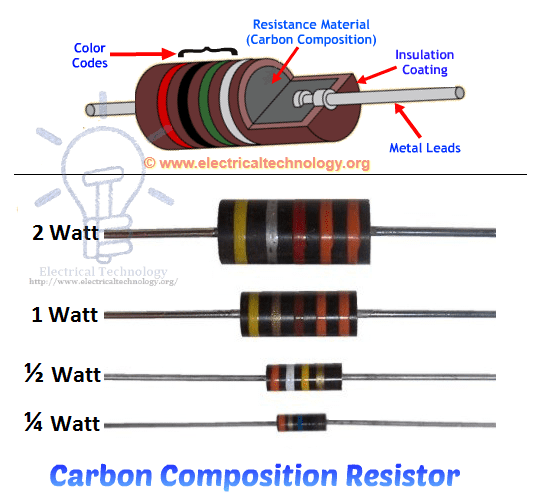
There are 3 main types of resistors based on their composition: carbon-composition resistors, carbon-film resistors, and metal-film resistors.
What is Colour code of resistor?
A 1000 Ω resistor has a four-band colour code following a colour sequence of Brown, Black, Red and Gold. The 1000 Ω resistor has a mulitplying factor of 100 (Red) and a tolerance level of ±5% (Gold).
Is a light bulb a resistor?
The reason a light bulb glows is that electricity is forced through tungsten, which is a resistor. The energy is released as light and heat. A conductor is the opposite of a resistor.
What is difference between resistor and resistance?
Resistance is designated with R and its unit is the ohm (Ω). A resistor is a device designed to produce resistance. Resistors can be used to limit current, divide voltage, or generate heat.
How do you test a resistor?
One lead from the circuit. It doesn't matter which one next you will want to obtain an electrical
What is Ohm's law unit?
Ohm's law formula is written as; V ∝ I. Therefore, V = RI where R is a constant called resistance. R depends on the dimensions of the conductor and also on the material of the conductor. Its SI unit is Ohm (Ω).
What is resistor and conductor?
Conductors and resistors Substances in which electricity can flow are called conductors. A piece of conducting material of a particular resistance meant for use in a circuit is called a resistor. Conductors are made of high-conductivity materials such as metals, in particular copper and aluminium.
13 Resistor definition Images
Pin de ashley harris em math and science Esquemas eletrnicos

Variable Resistors Check more at httpblogblackboxsrucategory

Resistor Types of Resistors Fixed Variable Linear NonLinear

Resistor Color Code Calculator 345 6 Band Resistors Calculation
Types of Google and Search on Pinterest

SPECTROL 3TURN 5KOHM POTENTIOMETER 830122 New Old Stock C14B2

i choose this photo to represent resistance because this photo is the

Resistor lead forming tool by dnewman Thingiverse Arduino 3d Printer

LightEmitting diode connected to 120240 VAC This circuit shows 1 or

Type of resistor Resistors Resistor Electronic schematics

SMD resistor sizes Basic electronic circuits Electronic circuit

mjlorton Solar power Arduino Capacitor

Post a Comment for "Resistor Definition"