Work Transfer In Adiabatic Process

Work transfer in adiabatic process
Adiabatic electron-transfer is a type of oxidation-reduction processes. The mechanism is ubiquitous in nature in both the inorganic and biological spheres. Adiabatic electron-transfers proceed without making or breaking chemical bonds. Adiabatic electron-transfer can occur by either optical or thermal mechanisms.
Is work constant in adiabatic process?
An adiabatic process in which no work is performed is an example of a constant energy process.
What is ∆ U in adiabatic process?
In adiabatic process no exchange of heat occurs between system and surrounding so Q=0. Thus, ΔU is equal to adiabatic work.
What is the work done in adiabatic and isothermal process?
In an isothermal system, work done is because of the change in the net heat content of the system. In an adiabatic process, the work done is because of the change in internal energy.
Is there mass transfer in adiabatic process?
In an adiabatic process, no heat or mass transfer takes place across the walls or boundary of system.
What are two conditions adiabatic process?
The adiabatic process is a thermodynamic process in which there is no heat transfer from in or out of the system. An adiabatic process is a reversible process with constant entropy for an ideal gas.
What is the condition for adiabatic process?
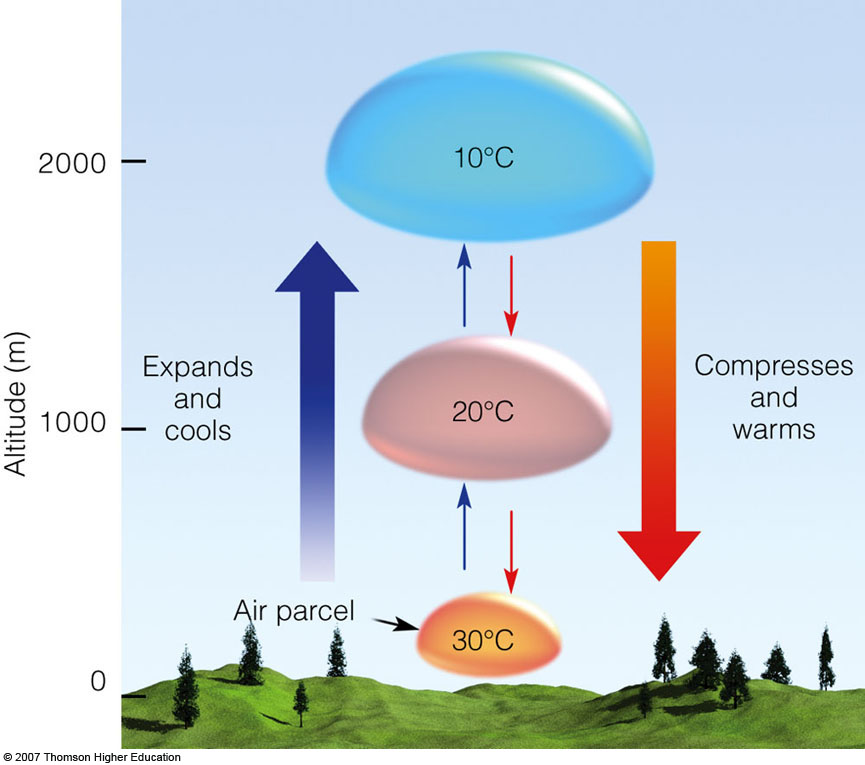
Adiabatic processes occur when no heat is exchanged between the system and the environment, and the energy of the system only changes because of energy transferred in the form of work. Adiabatic processes can occur when gases either contract or expand, as long as no heat is added or removed from the gas.
Why is work negative in adiabatic?
when a gas compresses adiabatically , work is done on the system ,therefore dW must be negative i.e. change in internal energy is positive it means internal energy of the system would increase and hence the temperature of the gas will increase.
Why work done is less in adiabatic process?
Complete step by step answer: , work done on it and its temperature increases and the gas does work and its temperature drops. Since, both Pressure and Temperature decreases hence pressure is less than the pressure of isothermal process. So, Work done in reversible adiabatic is less.
Is work done in adiabatic process always negative?
It can be either positive or negative in sign, depending on whether the gas expands or is compressed, respectively.
Is U 0 in adiabatic process?
An adiabatic process is one in which no heat is gained or lost by the system. The first law of thermodynamics with Q=0 shows that all the change in internal energy is in the form of work done. This puts a constraint on the heat engine process leading to the adiabatic condition shown below.
Why it is Delta U is equal to adiabatic work?
Thermodynamically, an adiabatic process is one in which no heat is exchanged between the system and its surroundings, neither during expansion nor compression. An adiabatic work equals $\Delta U$.
Why CV is used in adiabatic process?
In an adiabatic expansion there is not heat exchange, technically the gas cools down because it does work. We are using Cv here only as means to account for the change in internal energy, which happens to be equal than in a constant volume process.
Is there work transfer in isothermal process?
The work done in an isothermal process is due to the change in the net heat content of the system. Meanwhile, the work done in an adiabatic process is due to the change in its internal energy.
Is there work in adiabatic?
Adiabatic free expansion of a gas Because there is no external pressure for the gas to expand against, the work done by or on the system is zero. Since this process does not involve any heat transfer or work, the first law of thermodynamics then implies that the net internal energy change of the system is zero.
What is the work done in an adiabatic process when the temperature?
Wadi=y−1R(Ti−Tf)=y−1R(T−T1)
Does adiabatic have heat transfer?
An adiabatic process is defined as a process in which no heat transfer takes place. This does not mean that the temperature is constant, but rather that no heat is transferred into or out from the system.
Is heat transfer zero in an adiabatic process?
For an adiabatic process, the heat will be zero. So, from the first law of thermodynamics, the change in internal energy is the total of heat and the work done.
Is mass constant in adiabatic process?
An adiabatic process is one in which no heat energy is transferred (Q=0) . Mass does not factor in.
Are all adiabatic processes isothermal?
The major difference between these two types of processes is that in the adiabatic process, there is no transfer of heat towards or from the liquid. On the other hand, in the isothermal process, there is a transfer of heat to the surroundings to make the overall temperature constant.
12 Work transfer in adiabatic process Images
Adiabatic Process Engineering notes Physics and mathematics

Jet Engine Pv Diagram
Higher education Education Student

ConstantVolume Calorimetry for more precise work than the coffeecup

Adiabatic Cooling Tower Cooling tower Manufacturing Tower

Adiabatic Lapse rate wetdry Lapse rate Latent heat Rate

What are the different Thermodynamic Processes ExtruDesign in 2021

Comparison of Isothermal Isobaric Isochoric and Adiabatic processes

A mathematical derivation of the equations relating the pressure

Modes of heat transfer Conduction convection radiation Conduction

Changing forms of energy

Post a Comment for "Work Transfer In Adiabatic Process"